Port discovery & details
What it does. Lists live listening bindings with protocol, bind address, process identity, and connections.
Why it matters. You see what is actually listening instead of reconstructing it from config files.
Features
Each capability below ships in the current agent, desktop, CLI, or Cloud dashboard. We do not list roadmap items as product.
What it does. Lists live listening bindings with protocol, bind address, process identity, and connections.
Why it matters. You see what is actually listening instead of reconstructing it from config files.
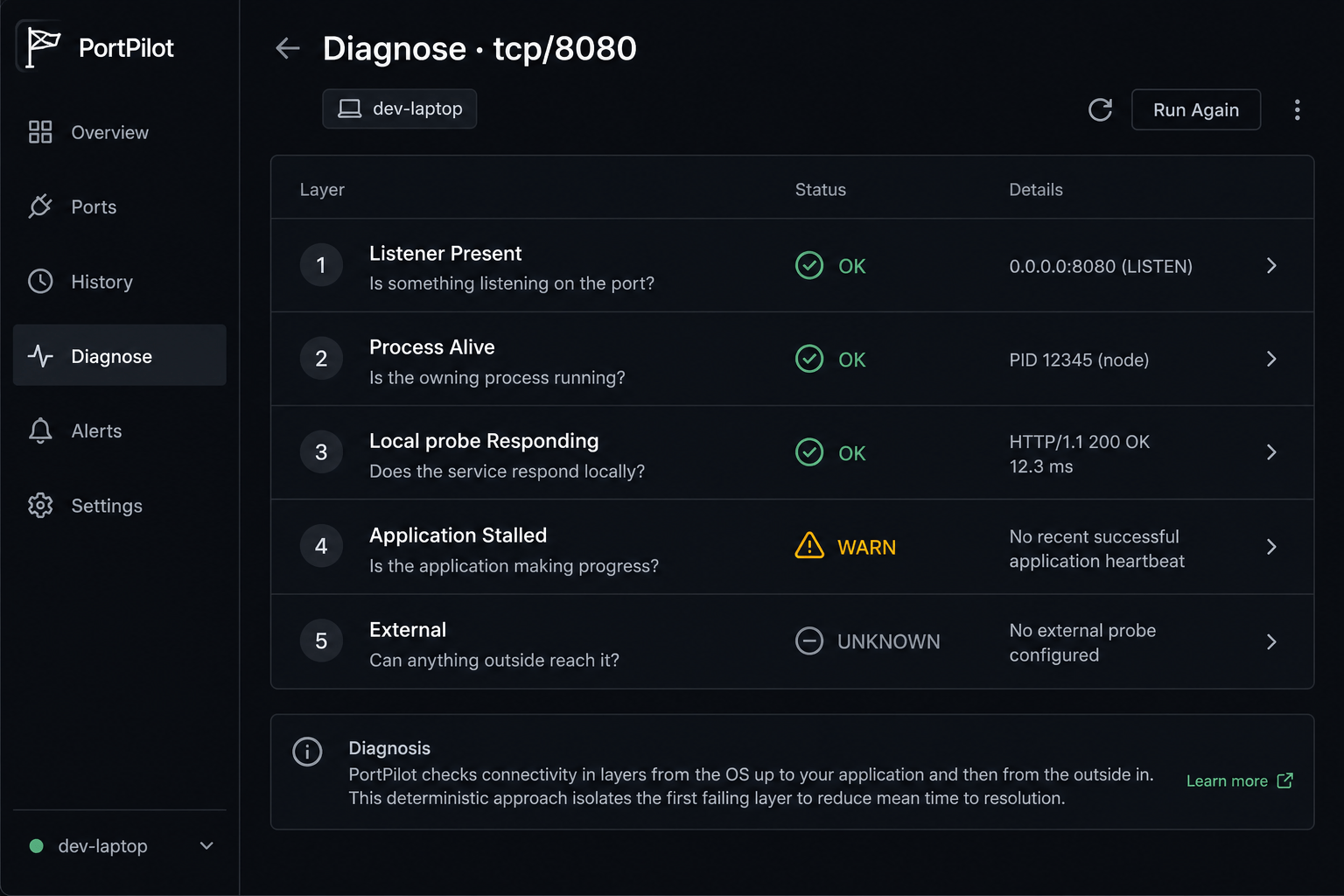
What it does. Layered Diagnose (listening, process, loopback HTTP, service, firewall, container, reverse proxy) with honest Unknown.
Why it matters. You get a structured explanation instead of a fake green check from an internet probe.
What it does. Kill with ProcessGuard; start/stop/restart when a service is identified.
Why it matters. Act on the owner of the port without a shell or a recycled pid.
What it does. SQLite history on the host. Filter and search when the agent is online (Free and Pro).
Why it matters. Overnight deaths and flapping ports stay visible after restart.
What it does. Short-lived XXXX-XXXX codes. Outbound WebSocket only. Free: one machine.
Why it matters. Remote core controls without exposing the agent inbound.
What it does. Inspect on Free. Mutate PortPilot-named rules on Pro (Windows netsh, Linux UFW).
Why it matters. Allow or block a port without turning PortPilot into a general firewall console.
What it does. ngrok API expose/stop/restart on Pro. Not Cloudflare.
Why it matters. Share a local listener without a second tunnel product in the critical path — if you already use ngrok.
What it does. Read-only Engine and nginx/Apache/Caddy/Traefik awareness.
Why it matters. Context on the binding. Not a Compose or proxy manager.
What it does. status, doctor, ports, diagnose, history, pair, tunnels, docker, proxy.
Why it matters. The same host data from SSH when you are not in the GUI.
What it does. Sync, notifications, account metadata backups — Cloud subscription. Dashboard pairing exists on Free for one machine.
Why it matters. Fleet continuity without making local discovery depend on Cloud.
Features
Listening sockets, process identity, layered health, and history that survives restarts - from Windows and Linux agents that speak the same protocol.
Kill, service, and firewall actions go through an allowlisted helper with ProcessGuard. The agent validates every action independently of the UI.
See how ports relate to ngrok tunnels, container publishes, and nginx / Caddy / Traefik / Apache routes - read-only awareness, not another CLI to babysit.
Pair machines for a fleet dashboard, durable sync, notifications, and account backups. Local discovery keeps working when the cloud is offline.
Command palette
Diagnose, kill, firewall, and fleet filters from Cmd+K - offline machines stay blocked; destructive actions still confirm.